Can Google see your enquiries?
If you pay for adverts and cannot see which clicks turned into enquiries, Google is guessing on your behalf — and so is Meta. Whether they can see them is decided by a few pieces of code on your own pages. Open a page of your site, press the button, and this tells you what is there, in words rather than in a console.
Submitted to the Chrome Web Store and waiting on review. This page links to it there as soon as it is published. Until then, Admiral checks your tracking for you when it sets up your campaigns.
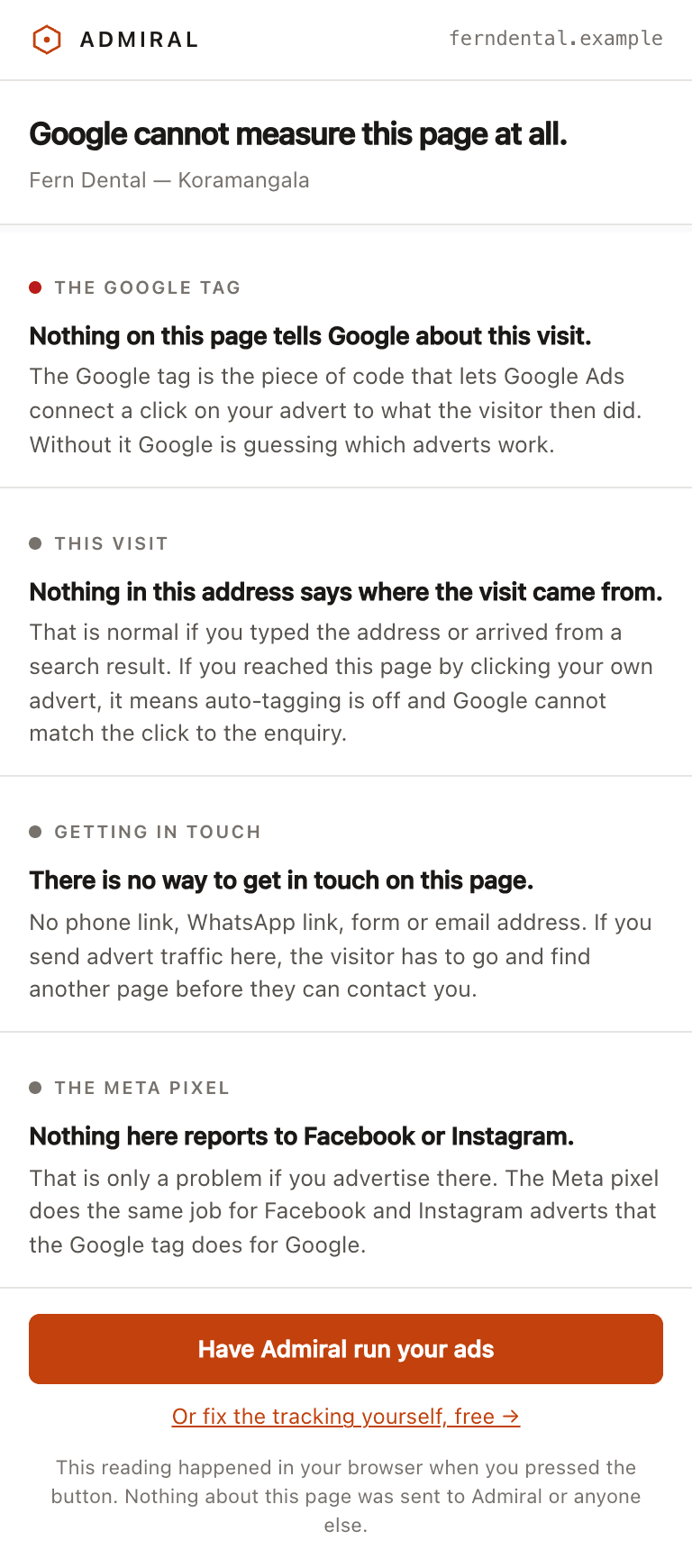
A whole answer, in one panel
This is a dental practice paying for adverts whose pages tell Google nothing at all — the commonest fault there is, and one almost nobody has ever been shown. Every line says what was found and why it matters. There is no score, and nothing to interpret.
The reading happens in your browser when you press the button. Nothing about the page is sent to Admiral or to anyone else.
What it checks
One reading of the page in front of you. There is nothing to configure and nothing to sign in to.
Whether Google can see the page at all
The Google tag is what lets Google Ads connect a click on your advert to what the visitor did next. The check names the Google Ads account it found, or says plainly that there is nothing there.
Whether more than one account is watching
Every Google Ads account the page reports to is named. Two is often perfectly normal — an agency running ads alongside you — and it is only a problem if both count the same enquiry, which a page cannot show. So it is reported as a fact to check, never as a fault.
Whether the visit can be traced back to an advert
Google and Meta add an identifier to the address when somebody clicks an advert. If it is missing when it should be there, auto-tagging is off and the click cannot be matched to the enquiry.
How somebody would actually get in touch
Phone links, WhatsApp links, forms and email addresses are counted, because each one is a moment that has to report back before Google learns an advert worked.
Whether a cookie banner is holding the tags back
A consent banner may stop the tags until a visitor accepts. It is the commonest reason conversions go quiet without anyone having changed anything.
It cannot read a page you did not ask it to
Most extensions ask for permission to read every site you visit, for ever. This one does not have that permission and cannot be given it. Chrome grants it access to a single tab at the moment you press its button, and takes that access away again when you leave the page. Between readings it can see nothing at all.
The reading itself happens inside your browser. Nothing about the page — not the address, not the tags, not the account numbers — is sent to Admiral or to anyone else. There is no sign-in, so there is no account for it to belong to.
It reads and never writes. It cannot change your site, your tags or your advertising, and the check on your own pages reads no cookies at all.
The one exception is worth stating plainly, because it is the sort of thing a privacy note usually buries. When you ask it to read your LinkedIn company page, it reads a single value LinkedIn sets in your browser — the token LinkedIn requires on its own requests — and uses it only for that one request, inside the LinkedIn tab. It is never stored, never sent to Admiral, and never read on any other site. The extension holds no permission to read cookies as a browser extension can; it is your own already-signed-in session doing what you asked.
If you already use Admiral
The same extension can read your own LinkedIn company page into your business profile, so you do not type your description, industry and location again. You start that from inside Admiral, it uses the LinkedIn session already open in your browser, and you review every field before anything is saved.
Nothing is saved without you pressing a button, and what you have already written is never overwritten.
Admiral plans, builds and improves Google and Meta ads for small businesses, and asks before anything spends. We built this because tracking is the step that stops people before any advertising can start, and because a straight answer about it is small enough to give away.
If the check tells you your tracking is missing and your site runs on WordPress, the fix is also free. There is a plugin for that. If you would rather not do any of it yourself, see what Admiral does.
Admiral reads your site, plans the campaigns, checks the tracking, and asks before anything spends.
Campaigns arrive paused