Meta Ads · 27 August 2026 · 8 min read · a ten-minute platform choice
Meta Ads vs Google Ads for Indian SMBs in 2026
The wrong question is which platform is better. The right one is whether anybody is searching for what you sell. A ten-minute demand check, the settings each platform uses by default, and a decision table by business type, plus what each platform quietly does to a small budget by default.

Built Admiral · runs the audits on real accounts
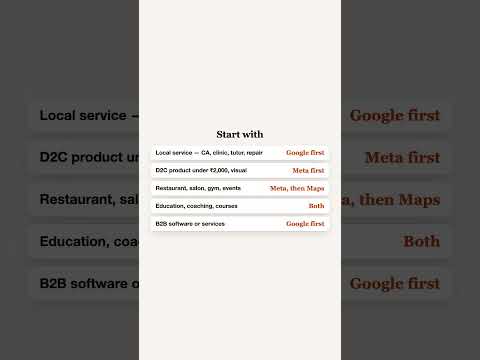
Every month somebody asks us whether they should be on Meta or Google, and every month the honest answer starts with a different question: is anyone searching for what you sell? If yes, Google gets the first rupee, because a person typing “CA for GST filing in Indore” is worth more than a thousand people scrolling past a picture of your office. If no (nobody searches for a new snack brand by name), then Google cannot help you and Meta can.
Below: how to answer that in ten minutes, what each platform does by default, and a decision table by the kind of business you run.

The ten-minute demand check
Open Google’s Keyword Planner (free, inside Google Ads, under Tools). Type the plain words a customer would use: not your brand, not your clever phrase. Set the location to India, or your city. Read the monthly searches for the exact terms, not the padded “related ideas” total, which inflates everything.
Under about 300 searches a month for your core terms, Google Search will struggle to spend a budget on anything but junk. Over 2,000, you have a Search business. In between, run Search small and put the rest where the eyes are. We wrote the walk up in detail in the demand-check note.
What Meta does with a small budget
Open the age, placement and device breakdowns on any small Indian account that ran on defaults and the same three patterns appear. They are worth more than any benchmark report.
- Age. The under-45 bands take most of the delivery and most of the spend, and for a business-owner product they produce nothing; the leads sit in 45+, and click-through climbs with every age band. Worse, Meta’s Advantage+ Audience quietly overrides a stated age floor; you have to switch it off, not just set the age.
- Placement. Facebook Feed and Reels carry the leads on roughly half the spend. The other half (Stories, Marketplace, Audience Network, Instagram) produces nothing; Marketplace in particular soaks up impressions at a click-through rate that rounds to zero. Automatic placements, which is the default, put you in every one of those.
- Device. Overwhelmingly Android, and so are the leads. Desktop is a rounding error.
None of that is a reason to avoid Meta. It is a reason not to run it on defaults. Set the age floor and disable Advantage+ Audience, choose Feed and Reels by hand, and the same budget buys a very different account.
What Google does with the wrong words
Google’s embarrassment is different. The classic mistake is to bid on the broad research terms (“ppc” and its cousins at 49,500 searches a month) and spend for nothing at all, because the people typing those words are students and job-seekers. The precise service terms next door draw a fraction of the volume and every one of the leads. On Google, the trap is not the platform; it is the words, and the demand check above is how you avoid it.
The other Google-specific thing: for a B2B product, buying intent in India is thin and the US is where the bids are. “AI governance platform” runs 1,600 searches a month in the US at a ₹6,844 top-of-page bid; the Indian equivalent is 140 searches at a third of the price. If you sell to companies, expect to advertise in dollars.
The decision table
| Business | Start with | Why |
|---|---|---|
| Local service: CA, clinic, tutor, repair | Google first | People search for it with a city in the query; nobody scrolls Instagram wanting a plumber. |
| B2B software or services | Google first, US if you sell there | Buying intent lives in search. Meta's interest graph has no category for most B2B. |
| D2C product under ₹2,000, visual | Meta first | Impulse, image-led, and search volume for the product is usually tiny. |
| Restaurant, salon, gym, events | Meta first, Google Maps second | Local, visual, time-bound. Feed and Reels do the work; Marketplace and Stories do not. |
| Education, coaching, courses | Both: Google to catch, Meta to remind | High search intent plus a long decision; retarget the searchers on Meta. |
| Real estate | Meta for reach, Google for the serious | Meta fills the top; Google's 'flats in [area]' fills the bottom. Age floor on Meta matters here more than anywhere. |
What each platform does to a small budget by default
Google ticks Search Partners and Display on a new Search campaign, sets location to “presence or interest”, and suggests broad match. Untick, set to presence, use phrase. Meta turns on Advantage+ Audience, automatic placements including Audience Network, and optimises for link clicks rather than landing-page views. A large share of paid clicks never become a page view. And note the account is prepaid with 18% GST taken off the top: ₹3,000 loaded is ₹2,542 of ads.
The answer, then
Run the demand check. If the words exist, Google first, on phrase match, presence only, networks off. If they do not, Meta first, 45+ if your customer is over 45, Feed and Reels only, Advantage+ Audience off. Either way, check what counts as a conversion before you trust a single number the platform shows you. Admiral runs both accounts through the same checks and puts the verdict on one money axis, but the table above works without it.
Connect Google Ads or Meta (or both) and Admiral audits each on its own checks and tells you, in rupees, which one is earning its budget. Free for 3 days, no card, nothing changes without your click.